





National Network Of Volunteer Pilots Deliver Critical Aid Ahead Of Federal Response
The Operation Airdrop disaster-response organization booth at SUN ’n FUN is recruiting pilots and corporate sponsors to help in their non-profit efforts to provide disaster relief with generation-aviation aircraft.
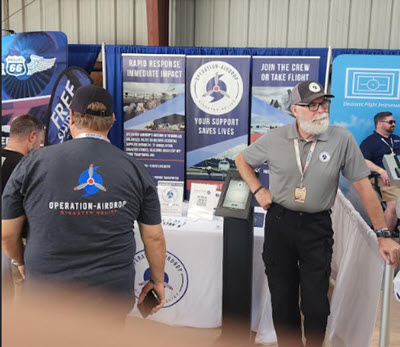
Russ Keith, executive director of Operation Airdrop based in Lewisville, Texas, said, “We are the final mile of getting supplies to areas cut off after national disasters.” He said the group needs general aviation pilots and ground volunteers to help the organization with the mission.
“We beat the state and federal disaster assets by eight to 10 days,” Keith said, because they are able to avoid federal bureaucratic red tape.
He cited the organization’s work in both the North Carolina mountains following Hurricane Helene and with the flood disaster in Central Texas last July.
Keith said it was especially difficult in the North Carolina mountains due to washed-out roads and mountainous terrain. There were 200 fixed-wing planes and 130 helicopters helping in that region. The organization first sets up outside the impact area, then flies in and coordinates with churches, fire departments and other local groups. Then the groups take out supplies on four-wheelers to individual houses if they need. He said often people cannot get out at all and the helicopters can land in yards to deliver supplies; this was critical in North Carolina.
In the Central Texas floods, he said they used 106 airplanes and helped deliver 175 chainsaws to the disaster areas working out of a base at the Burnet, Texas airport.
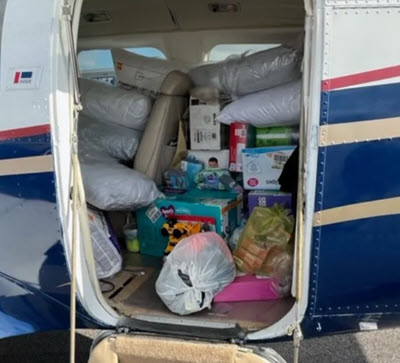
While the group does emergency supply delivery, they also provide aerial reconnaissance, disaster-logistics support, and can organize and deploy a nationwide network of pilots, ground crew and other aviation professionals.
Their biggest issue today is money, Keith said. They often get a big, one-time check from donors to help at a disaster, but they need ongoing funding for the Lewisville-based organization. Most of the money comes from “the little people” who help out, so he is really seeking a larger corporate donor to help.
Keith said what he would like to do next is create a tornado “hot-shot” plane. He said the organization needs a Cessna Caravan already set up with generators, chainsaws and other disaster relief supplies specifically ready for tornado outbreaks, which do not provide much warning and require a short, quick response.
He said the group operates on a mission-first mindset, emphasizing safety, coordination and rapid execution with small aircraft that can access remote areas quickly.